Vote #1 CHANEL GARDNER
Otago Regional Council

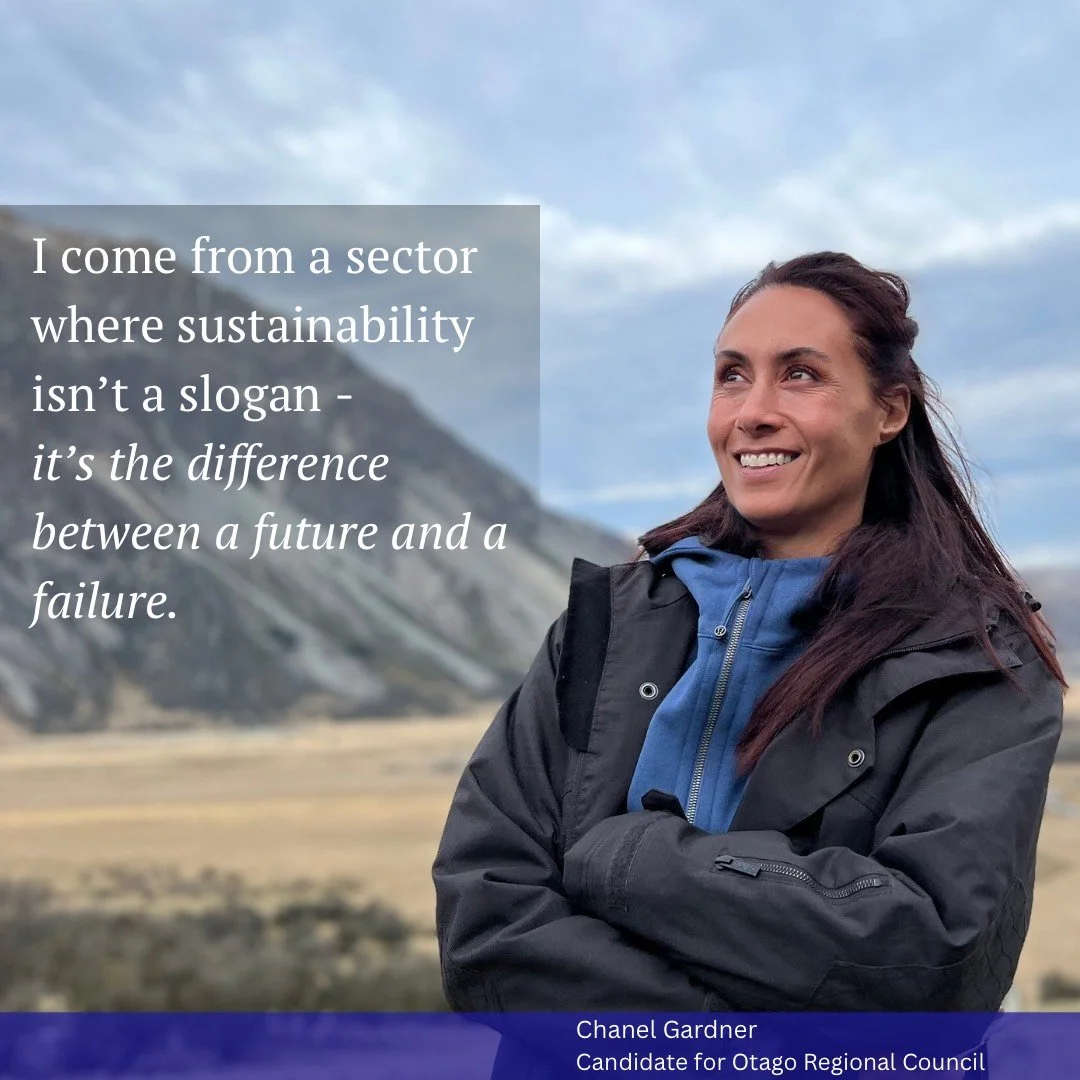
Chanel Gardner is standing for the Otago Regional Council in the Dunedin constituency. With a background in law, primary industries, and environmental leadership, she’s committed to restoring focus and delivering practical, community-minded outcomes.
Prosperous People, Thriving Environment
-
Otago ratepayers expect a council that uses resources carefully, delivers on agreed priorities, and plans for the long term. The Otago Regional Council has a unique advantage: significant reserves, investments, and full ownership of Port Otago and Chalmers Properties. If managed responsibly, these assets can help keep rates stable while funding projects that matter for people, the economy, and the environment.
As a councillor, I will advocate for a disciplined spending approach that strengthens public trust, delivers measurable outcomes, and ensures every dollar works for Otago.
Disciplined, Strategic Planning
Major spending decisions should be guided by clear objectives and robust analysis, with projects assessed on evidence, value for money, and long-term community benefit.
Using Regional Assets Wisely
Dividends from Port Otago and Chalmers Properties should support initiatives with lasting impact, such as environmental restoration, climate resilience, and regional infrastructure, not simply be absorbed into operating budgets.
Efficient Service Delivery
Council should deliver more with what it has. Smarter processes, technology, and coordination can reduce duplication and improve services without constant calls for higher rates.
Transparency and Accountability
Ratepayers must be able to see how money is allocated and what results are achieved. Open reporting on budgets, investments, and project performance will build confidence in council decisions.
Balancing Today and Tomorrow
Good financial management meets today’s needs while preparing for future challenges. I will prioritise spending that delivers immediate benefits and strengthens Otago for the long term.Description text goes here
-
Otago’s waterways matter. But real environmental progress requires more than good intentions; it requires local knowledge, science that reflects our catchments, and practical solutions that work for both nature and people.
As a regional councillor, I will advocate for a freshwater policy that delivers environmental outcomes without undermining local livelihoods, cultural values, or food production.
Catchment-Based Management
One-size-fits-all rules don’t work across Otago’s diverse landscapes. I support catchment-specific plans developed alongside local communities, landowners, mana whenua, and science experts — with clear goals and practical tools.
Integrated Land-to-Sea Thinking
Healthy rivers don’t end at the river mouth. Otago’s marine ecosystems, including rock lobster, blue cod, and other coastal species, depend on appropriate freshwater flows and nutrient levels.
I will push for policy that considers estuaries and downstream impacts, not just upstream restoration.
Science-Informed, Not Model-Driven
Too much regional policy is driven by abstract models and generic nutrient numbers.
I will fight for decisions grounded in real-time monitoring, seasonal variation, mātauranga Māori, and long-term trends.
Respect for Customary and Commercial Harvesting
Overregulation of estuaries and river mouths threatens both Treaty-protected customary practices and the regional economy. I will ensure any new freshwater or habitat rules do not erode access to sustainable seafood or undermine whānau and small businesses who rely on it.
Partnership
Farmers, fishers, marae, community trusts, and science groups should be partners in freshwater management. I will back co-designed solutions, incentives for innovation, and resourcing for community-led restoration projects that will contribute valuable metrics back to Council. Exploring endorsement of Aotearoa’s first UNESCO Biosphere Reserve in Otago could also provide an opportunity for accelerating positive climate change for Otago communities.
-
Leadership matters. Otago communities deserve clean rivers, safe harbours, and confidence that wastewater systems are being managed properly. The Regional Council’s role is to regulate fairly, apply standards consistently, and ensure the public has clear information about performance.
Consistent Standards
Territorial authorities and private industry must be measured against the same compliance framework. Regulation should be applied evenly and fairly.
Transparent Reporting
Introduce public dashboards showing wastewater monitoring results across Otago. Communities deserve accessible information on when discharges occur and how consent holders are tracking.
Proactive Oversight
Strengthen monitoring systems to detect early signs of non-compliance and act before issues escalate into environmental harm.
Whole-of-System Thinking
Ensure wastewater management connects freshwater and coastal policy. Rivers, lakes, and harbours are linked, and our strategy should reflect that.Description text goes here
-
Otago’s coastlines are unique; home to taoka species like hoiho, penguins, albatross, and thriving commercial and customary fisheries. Protecting this heritage requires more than central government headlines; it requires local solutions grounded in science, community, and respect for those who live and work on the water.
As a regional councillor, I will advocate for a marine policy that safeguards ecosystems while ensuring small-scale fishers, iwi, and communities can continue to harvest and enjoy kaimoana into the future.
Practical Protections, Not Politics
Marine management has been dragged into partisan battles. My focus will be on what ORC can realistically achieve: coastal monitoring, estuary restoration, sediment management, and advocating for balanced fisheries policies that protect Otago’s future.
Catchment-to-Coast Connection
Healthy coasts depend on healthy rivers. Sediment, nutrient run-off, and freshwater flows all shape our estuaries and marine ecosystems. I support integrated land-to-sea planning that recognises the connection between farming practices, waterways, and sustainable fisheries.
Science, Mātauranga Māori, and Local Knowledge
National policy often swings between ideology and industry pressure. Otago deserves better. I will push for decisions based on robust local science, seasonal monitoring, mātauranga Māori, and the lived knowledge of those who depend on the sea.
Protecting Customary & Community Access
Regulation must respect Treaty-protected practices and the realities of local livelihoods. Overreach threatens mahika kai, whānau food gathering, and the resilience of small fishing businesses. I will advocate for policies that protect both cultural rights and regional economies.
Partnership and Innovation
Real progress will come from partnership: iwi, fishers, scientists, local councils, and community trusts working together. I support co-designed solutions, marine biodiversity projects and habitat protection. Exploring endorsement of Otago as New Zealand’s first UNESCO Biosphere Reserve could position our region as a leader in sustainable marine stewardship.
-
ORC Environmental Investment: Risk and the Path to Accountability
Cross-reference: Background Paper 15 Oct 2024, ORC Council Agenda 25 June 2025, Item 10.4 “Environmental Funding” (p.579+) and Frequency NZ Summary Report (p.880+)
The Immediate Situation
From 1 July 2025, the Otago Regional Council set aside $2 million each year from reserves for a new Large-Scale Environmental Fund. Frequency NZ was contracted to design the governance and delivery model for the new fund. Their reports were tabled at council in May and June 2025, but no final framework was adopted. As a result, the fund is live in the Annual Plan, but it has launched without a clear governance model, investment register, or outcome framework to track return on investment for ratepayers.
Where the Report Helps
Frequency’s work recognised that community demand exceeds the ECO Fund’s capacity and that larger-scale, longer-term projects require new investment pathways. The report explored different process models, canvassed stakeholder engagement, and identified the need for clearer eligibility criteria. This work has value as background design and consultation.
Consultation and Methodology; A Caution
Frequency’s process relied heavily on consultation with the “users” of environmental funding; rūnaka, Aukaha, Mana-to-Mana, catchment groups, and NGOs such as Halo, Predator Free Dunedin, Orokonui, and others. This was logical: these are the organisations most likely to apply for the new fund. They also looked outward, scanning how other regions and central government structure similar funds, drawing lessons about contestable vs. strategic allocations and advisory panel design.
This work is valuable, but it is not without blind spots. By leaning so strongly on those who will later apply for funding, the model risks reflecting the interests of applicants rather than the wider community. Ratepayer associations, primary industries, and business groups were not part of the consultation, nor was there structured financial analysis of what $2 million per year drawn from reserves means for council resilience. The comparative scan was about process, not about measurable return on investment.
None of this is unusual, most fund design processes look first to “users” and comparators. The caution is that councillors must balance that input with their broader mandate: financial diligence, stewardship of reserves, and public accountability. The voices of applicants are necessary but not sufficient. Without counterweight from independent financial scrutiny and outcome-focused design, the fund risks becoming another grants programme shaped by demand rather than a disciplined investment vehicle delivering results.
The Gaps and Risks
Financial Diligence
The report downplays the fact that reserves are built from ratepayer surpluses and Port Otago dividends. Spending $2 million annually without a replenishment plan reduces ORC’s resilience to floods, biosecurity incursions, and economic shocks. Framing this as “from reserves, not rates” misleads the public and obscures the opportunity cost.
Governance
Councillors remain the final decision-makers, but there is no transparent framework, no conflict register, and no published scoring criteria. Without these, allocations risk being perceived as discretionary.
Accountability
Current reporting focuses on projects funded and dollars spent. There is no investment register, no outcome framework tied to the Long Term Plan, and no systematic measurement of return on investment. Without metrics, ORC cannot show ratepayers whether $1 million buys one hectare of restoration or one hundred.
Duplication
The report makes little reference to DCC or central government funding streams. Without joint mapping, duplication and double-dipping are highly likely.
Reputation
Launching a $2 million fund under these conditions undermines ORC’s credibility. Ratepayers expect transparency and results, not another opaque grants programme.
A Credible Path Forward
To safeguard reserves and deliver measurable returns, ORC must adopt a disciplined Investment Accountability Model.
A comprehensive public investment register should cover all contestable, direct, and council-delivered allocations.
Outcome metrics must establish baselines and track tangible results such as hectares restored, water quality gains, pest reductions, and cost per outcome.
Co-funding leverage should be mandatory for large awards, ensuring ratepayers do not carry the full burden.
Technology platforms such as Submittable or AmpliFund should provide structured reporting, GIS integration, and a public Impact Dashboard.
An independent audit of the last five years of environmental spending should set a clear baseline.
Interim Frequency findings must be published before further allocations are approved, locking in reforms before reserves are committed.
UNESCO Biosphere A Strategic Opportunity: A Multiplier, Not a Mandate
If ORC delivers the reforms outlined here; a full investment register, clear outcome metrics, co-funding rules, transparent dashboards, and independent audits we will have a credible, disciplined model of environmental investment. That model stands on its own, fully aligned with council’s financial mandate and duty to ratepayers.
The opportunity is that this work can go further. By aligning with a UNESCO Biosphere framework, ORC would not take on new costs or responsibilities. Instead, the Biosphere would sit over the top of what we are already doing, acting as a multiplier.
It would benchmark ORC’s results against global standards, give visibility and credibility to our Impact Dashboard, attract outside investment, and integrate our funding with DCC, rūnaka, and community contributions. In short, the Biosphere is not something ORC funds; it is a framework that makes every reserve dollar work harder.
Handled this way, Otago could become the first region in New Zealand to show ratepayers and the world that environmental spending is not just accountable, but leveraged turning prudent governance into a platform for wider recognition, funding, and results.
My Position
If elected, I will ensure the council re-anchors this fund in its core mandate: financial stewardship, accountability, and measurable outcomes for ratepayers. Environmental funding is important, but it must be treated as investment with clear returns, not as discretionary spend. If I don’t get in I’ll likely lobby everyone anyway!
Stay Updated & Get Involved
Chanel Gardner ORC Candidate 2025
Authorised by Chanel Gardner | info@chanelgardner.nz | +64 21 389 953